Sunday, May 11, 2014

Maybe Japan is not really lost


Japan’s decline has become such conventional wisdom that you pick up a book like this and immediately expect an explanation of Japan’s “lost decade” (now turning into two decades), a period that coincides nicely with my own career; I first lived in Japan during the Bubble heyday, leaving for good  in the mid-90s, after the Kobe Earthquake and the Sarin Gas Attacks that marked such a pivot in Japan’s history. Like many Japanophiles at the time, I too gave up on the country and found myself studying less and less about the place, switching instead to China, which seemed far more exciting and new. With David Pilling’s new Bending Adversity: Japan and the Art of Survival  (which I found from a Sinica Podcast recommendation) I feel much more caught up.

The title “Bending Adversity” is a rough translation of 災い転じて服となす, which is a great, untranslatable Japanese phrase that you use when suffering hardships. The author, a Financial Times journalist who lived there through much of the 2000s, uses the 3/11 Tsunami as the context for the book, showing the uniquely Japanese way that people there endured the aftermath of one of their worst disasters.

“Japan is a country of good soldiers but poor commanders,” says Shijiro Ogata, one of many first-hand interviews from the book. The cleanup after the tsunami, like so much of what appears to be rudderless Japanese politics, seems to indicate a lack of direction — leadership— that is only made up for by the orderly, well-behaved reaction of individual Japanese, who one-by-one work together to cooperate in ways unthinkable in other countries. Looting and hoarding — seemingly inevitable consequences of disaster anywhere else — just don’t happen in Japan.

But what is the source of unique Japanese, orderly response to adversity? and will it continue? The author provides a nice overview of ideas like nihonjinron, so big back in the Bubble Days when the best-selling book was Ezra Vogel’s Japan as Number One. Then there’s a nice refresh of Japan’s historical rise, including the early victories over China and Russia back in the 1890s, continuing to the triumphs and ultimate tragedy of the War, followed by its unlikely recovery. By the time you get to the Bubble Days, you come away with an understandable awe at how such a success was possible, made even more incredible by the seeming inability to grow again after the early 90s crash.

Reviewing the various responses by Japanese governments since then — from the early, temporary defeat of the LDP in the 90s, to the unlikely rise of Koizumi in the 2000s, you are left with a sense of one dashed hope after another, and a real disappointment that the seemingly invincible country that rose after the Meiji Restoration has disappeared and may never come back again.

Still, behind the raw GDP numbers that show little or no progress in twenty years, and the overtaking by China in the number two spot worldwide, the author reminds us of all that is still great about Japan. If the impeccable design, cleanliness, great food, well-educated and orderly society with the world’s highest life expectance — if that’s a failure, then is it really so bad? Many parts of Japanese society have been restructured, with a greater awareness of the simple things in life, beyond the dreary economic numbers. As the author points out, Nelson Rockefeller, who died in 1979 one of the wealthiest and most powerful men in the world, had no iPhone or internet or any of the wonderful day-to-day luxuries that any Japanese person, living in a peaceful and generally cooperative society can take for granted. 

What I realized while reading this book is that maybe, instead of being “lost”, the last few decades are really how Japan has found itself.

Saturday, May 10, 2014

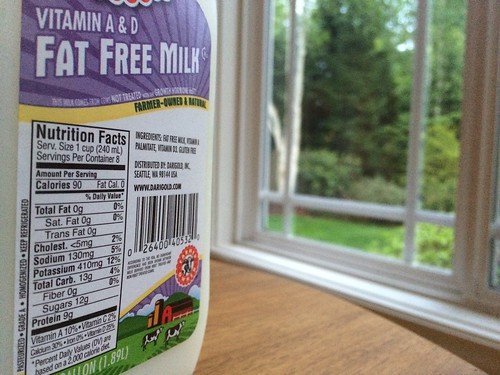
Call it processed milk

Our middle schooler came home from school yesterday and noticed for the first time that our family drinks whole milk, not the skim milk that her teacher had just recommended as the “healthier choice.” Delighted to have learned something at school that could immediately benefit the family, she suggested we switch.  Uh, not so fast.

Turns out there is no evidence that skim or low-fat milk is better for you than whole milk. In fact, a large five-year study of 12,000 middle schoolers found that kids who drink skim milk actually gain weight. A later study among two year olds found the same thing. So did another one, conducted on 10,000 kids published last year.

The American Academy of Pediatrics specifically recommends low-fat milk for all kids over 2. So does the official Kids Eat Right web site of the Academy of Nutrition and Dietetics. None of the web sites gives sources for their recommendations, but I assume they are simply following the decades of research that pretty conclusively shows a link between high cholesterol and heart disease. Whole milk has more fat, which means more cholesterol, which means more heart disease. Right?

Well, that sounds good in theory, but it appears to be based on research into a key component of milk (the fat), not milk itself. The best of science knows so little about how food reacts in the presence of other foods; it's not surprising that large studies often appear to disprove the received wisdom about something that seemed sound in theory. It could be that fat, by itself, causes high cholesterol and heart disease, but that fat consumed as part of a dairy product is good. In fact, I think that’s likely.

My opinion is converging on something that I first saw articulated by Michael Pollan (“eat food” — i.e. things your grandmother would recognize) and of course by many others in the natural food as well as ancestral health movements. Get as close to nature as you can.  When food is processed, it changes; whether that’s good or bad  — well, it depends. After all, heating something (aka “cooking”) is just a form of processing food. Salt is a type of rock, a mineral that you wouldn’t normally just go eat; but it can be a perfectly safe and healthy food additive. It depends. Still, when in doubt it pays to go back to basics. You step away from tradition at your peril. Thousands of years of dairy tradition — especially it’s associated with your genetic heritage — are not something to lightly deny. 

Bleeding out a natural component of cow’s milk (the fat) is a recent addition to the set of food choices we can make. Do you really know what you’re doing when you deprive your body of something that nature intended?

Non Fat Milk

Wednesday, April 30, 2014

[book] Proust and the Squid

I can’t remember who recommended this book to me, but as you’ll see by the end of this post, I feel compelled to write down what I learned from my reading of it.

The author,  Maryanne Wolf, a child development professor at Tufts in the Center for Reading and Language Research gives a detailed explanation of what happens — neurologically, socially — when we read, arguing that literacy is a cultural and learned trait that we should treat differently from the rest of our language instincts for communicating and thinking. If it took humans two thousand years to develop the written language, how can we expect children to adapt their minds properly after only two thousand days? (roughly the 7 years or so it takes to become functionally literate).

I came away with two thoughts: first, that reading well almost always means writing well; the best way to learn is to do. The author references this quote from Socrates (in Plato’s Phaedrus 275a), spoken to the inventor of writing:

You have invented an elixir not of memory, but of reminding; and you offer your pupils the appearance of wisdom, not true wisdom, for they will read many things without instruction and will therefore seem to know many things, when they are for the most part ignorant and hard to get along with, since they are not wise, but only appear wise.

Second, I’m thinking of the wisdom of the US Constitution, which admits that the text alone is not sufficient — a living, human trained judiciary is necessary to truly understand the meaning. Or the Catholic religious tradition, which says that we need both the text and the trained priesthood to understand the full meaning of the Bible. I’m back on my rant against those who claim to be knowledgeable just because they read The New York Times or whatever.

Understanding requires much more than simply knowing. I’m going to spend more time doing and less time reading.


Tuesday, April 29, 2014

Seth liked people who think for themselves

Some people have an influence that is difficult to see in the usual standards of pageviews, book sales, citations. Seth Roberts, I think, was one of those people whose real influence was felt one-on-one. I’m reminded of the movie where Forest Gump changed everything from Elvis Presley’s music to the Vietnam War, through a simple comment or gesture that seemed unimportant at the time, but turned out to be very profound.

Many of those whose lives he touched have stepped forward with eulogies that remind me how special he was. Here’s one from John Durant (a Steven Pinker-recommended author I respect):

Seth will be remembered for his work in self-experimentation. More than just his quirky findings – faces on TV, honey at bed, flaxseed oil – Seth taught that anyone can be a scientist.

Beyond this, I think Seth believed something else: that anyone can think for themselves. As someone who knew first hand about how modern science is conducted, he was not impressed just because a study showed this, or an expert said that. He was baffled about why people would make life-changing decisions based solely on what they read in The New York Times, or because they heard it from somebody with a sophisticated credential. Try it yourself! he would say. Check to see if it works on you!

Here’s another one from Seth’s friend Tucker Max (another best-selling author he mentioned frequently in our conversations):

Seth had intellectual courage as well. He examined ideas in themselves, not who they came from, and he defended and stood up for the things that were right, regardless of what they cost him. [emphasis mine]

Part of the reason I think Seth was so approachable was that he knew that good ideas could come from anywhere, that often the best ones come from ordinary conversations. Everyone who knew him personally appreciated those simple conversations the most, and we’ll never fully measure the outsize influence that resulted.

Monday, April 28, 2014

Remembering Seth Roberts

Like many people, I first heard about him back in 2006 through a chapter in the best-selling book Freakonomics. His strange habit of tracking various aspects of his life -- his sleep, his sense of balance – appealed to me in a geeky way. As a long-time self-quantifier myself, I found it reassuring to know that there were others out there, similarly interested in the practical day-to-day usefulness of science. Eventually I found his blog, and discovered that he was living near me in Beijing. A famous professor like him – a New York Times bestselling author and all that – might be hard to get ahold of, but one day out of the blue I sent Seth an email, wondering if he’d like to get together for lunch.


He replied in minutes and said sure, how about tomorrow?  I was so excited (such a famous guy!), and I invited him to the cafeteria at my office (then at Microsoft in Beijing). We exchanged unconventional ideas, the kind I suspect are true but that I don’t necessarily want to say in public (but that he posts unashamedly to his blog): how radiation is actually good for you, how if you want to lose weight you should only drink real coke, not the diet kind, about the benefits of homemade yogurt. We talked about Zeo and microbes and personal experimentation to see what works and what doesn’t.  It was a classic Seth Roberts conversation – challenging conventional wisdom, never taking anything for granted -- and I was hooked.


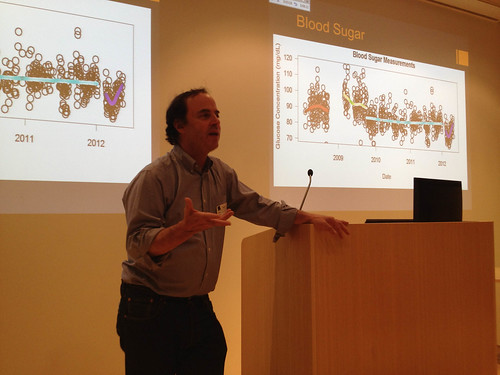
Later I invited him as a guest speaker at Microsoft (that’s a photo below). He introduced me to Steve Hansen, founder of Phonemica and another fascinating expat living in Beijing. The three of us got together regularly after that, always having amazing conversations. We talked about everything – unconventional ideas about pedagogy, the history and future of China, how little science really understands about diet and nutrition, about sleep.


Although Seth was very sharp about most things, there was always one nagging area where I thought he was underprepared. I wanted him to pay more attention to the rise of sensors, mobile devices, and all the incredible new self-tracking and discovery they make possible. He dismissed them mostly as “lipstick on a pig” ideas. Scientists know practically nothing about the real causes of illness and wellness – what good can technology do if we don’t even have a basic framework for understanding the basics about health?


He wasn’t impressed with Zeo, for example. He preferred keeping his own sleep journal, the old fashioned way with pencil and paper by his bedside. Most of his self-measurement was done with a stopwatch and paper. Come on, Seth, at least get an iPhone and enter the information online!


To prove him wrong, earlier this year I built a quick iPhone implementation of the analysis routines he was using on his PC. He had a script written in the statistical language R, and had accumulated quite a trove of data for himself. I made a basic implementation for iOS and showed him: see, you could have the same thing on a device that you carry with you everywhere!


He was intrigued. We got him an iPhone that he can use in both the US and China, and started communicated daily, through email and Skype, about the app. He can be very demanding, very obsessed with things I thought were trivial cosmetics. I would make a new build, send it to him for feedback, and he would always write back immediately, usually frustrated at my basic lack of understanding. Then we’d talk over the phone until I figured out what he meant; I’d go back and program some more, and repeat.


It was obvious that he had been carefully honing for years the techniques that he was (trying) to) teach me. “Imagine if anyone could find out, for themselves, which foods are good for them, which activities hurt their brain power and which help.”  He had already discovered some interesting things about himself this way; he could only imagine what would happen if this self-tracking power were in the hands of more people.


He was just settling in at Berkeley for the summer and we talked about the future. He was more optimistic about the app itself than I was. Normal people aren’t going to use this thing, I said. It’s too much effort. They’ll need to first understand more of the thinking behind it: they’ll need training, books, conferences. Seth will need promotion, turning him into a force like Chris Kresser, say, Dave Asprey, or Tim Ferris.


He thought about it a little and then said, no, the person he really admires is Nassim Taleb: to be able to be associated with an idea like the Black Swan, with friendships and associations with other really smart, unconventional people, with the freedom to think and explore the ideas whereever they lead.


He said this summer he was looking forward to lots of writing, and preparing for a talk at the Ancestral Health Symposium. He wanted to finish his book.  And of course, much, much self-experimentation.


I woke up on Saturday morning with an email for a bunch of changes he wanted from our app. I finished some, sent them to him for feedback, and he replied right away: it wasn’t good enough. I had other plans for the day, so I told him I’d get back to him tomorrow. Then he went for a hike.
Seth Roberts

Tuesday, February 04, 2014

Paleocon

I liked John Durant’s book (recommended by Steven Pinker) The Paleo Manifesto so when I heard about his new PaleoCon conference, I had to check it out. Today there was a talk by Seth Roberts, who I know from Beijing, which made it even more mandatory for me.

Everything about the “paleo lifestyle” is easy to caricature. Eating and acting like a caveman? You gotta be kidding. And it’s not just common sense that tells us this is stupid.  US News and World Report ranks Paleo dead last among 32 diets studied by their scientific advisors. University of Michigan Biological Sciences professor Marlene Zuk devotes an entire book to explaining the problems, which she calls Paleofantasy: What Evolution Really Tells Us about Sex, Diet, and How We Live. So who’s fooled?

Well, the problem is that the term “paleo” is just too easy to ridicule. Even Zuk’s book, I found, picks on a straw man that doesn’t exist. There really are no serious Paleo people who believe what she thinks they believe. A much better term, “Ancestral Health”, captures the idea more accurately: that we humans are mismatched between the urban “modern” environment in which we find ourselves today, and our rich, native habitat that our genes were designed for. You can quibble about the details — and the US News survey, for example, gets the details wrong — but I really don’t think the core idea can be controversial.

So PaleoCon gathers a number of interesting speakers to talk about different aspects of Ancestral Health, and I found today’s speakers to be especially full of good ideas.

Chris Kresser debunks several myths:

  • Vegetarians live longer than meat-eaters [the evidence is conflicting and doesn’t distinguish between processed and “natural” meat]
  • Eating saturated fat causes heart disease [eating eggs, for example, don’t affect cholesterol levels in most people]
  • Dairy is bad [maybe for those without the lactose-persistence gene, but not for the rest of us]
  • Fructose is a toxin [whole fruit is digested differently, and be wary of studies based on mice, which have different digestion of sugars]

Seth Roberts explains how he does his self-tracking:

  • Good sleep is the single most important aspect of good health
  • Take a tablespoon of honey before bed
  • Your body uses smell to decide whether to burn food or store it as fat: avoid exposing yourself to the same smells regularly.
  • Animal fat (like 60g of butter/day) can help with brain function

There’s more, including a bunch of additional ideas from David Asprey and others. I didn’t agree with everything, and some of the information was contradictory. But that’s what it’s like when you explore new territory with interesting people. It’s worth checking out.


NewImage

Monday, February 03, 2014

[podcast] The Second Machine Age

My favorite podcast, Econtalk, is always worth a listen. Here are my takeaways from this week’s interview with Erik Brynjolfsson of MIT and co-author of The Second Machine Age. His book has already been in my queue, and I’ll write more about it later.

[Sorry for the messy notes: I’m just putting the highlights here of some things I learned.  This deserves a much longer post]

  • Driverless cars may take longer to be adopted in inner cities because they aren't allowed to "bend the rules", which is pretty much required if you're going to survive in those crowded, chaotic conditions.
  • Measure the Consumer Surplus, which is about $300B/year. This metric, though difficult to measure, is arguably more relevant than GDP, because it more accurately reflects what really matters to people (how good is the "deal" I'm getting out of engaging in the economy?)
    • example: Wikipedia vs. Encyclopedia Britannica
    Better to teach statistics to high schoolers, not calculus
  • Voltaire: work addresses (1) boredom, (2) vice, and (3) need

Drivers of change

  • skill-biased technical changes
  • capital-biased technical changes
  • superstar-biased technical change

You must, must, must learn to adapt to new technologies.

That last point, about the importance of adaptation, is easy to ignore for most people because it’s so hard. Technology changes so quickly that even those who think they’re on top of it, you can miss the trends and fall behind.