Showing posts with label Apple. Show all posts

Wednesday, September 10, 2014

Apple Watch: the first wearable good enough to criticize

The Apple Watch launch event was so popular that the livestreamed version I saw kept breaking down, but I saw enough to be impressed.  My overall takeaway, to paraphrase what Alan Kay said about the first Macintosh: it’s the first wearable good enough to criticize.

As expected, Apple did it mostly right: a gorgeous high-quality design with plenty of personalization and rock-solid at its core time-keeping function. The first iPhone had brilliant, very clear positioning that helped excite people and make it easy to understand what was in fact a new product category.  Broken into three easy-to-understand pieces, Steve Jobs announced it was (1) a widescreen iPod  (2) great phone (3) the internet in your pocket.  Apple's Watch message isn’t quite that simple (or, frankly for many people, compelling) but here it is:
  1. incredibly precise timepiece,
  2. immediate, intimate way to connect,
  3. intelligent health and fitness companion
The first one is strong, though I might have said something about the fashion rather than the precision time-keeping. Do normal people really care that it’s within 50ms of the correct time?  On the other hand, a mass-market watch had better look nice — and personalized for me — or you’ll have a hard time getting people to wear it. With its mens/womens sizing, the plethora of band choices, and three versions (including the real gold “edition” ), Apple clearly raises the bar for all wearables. Competitors can no longer release crappy chunks of plastic now that Apple is here.

The second message, an intimate way to connect, is the weakest piece of the story. I get the “intimate” part — it’s something you put on your wrist, it’s part of your daily appearance — but why do I want to “connect”? If it’s a Dick Tracy-style phone on my wrist (it has a built-in microphone and speaker, so it’s possible), why not just say that? The goofy “share a heart beat” with your friends sounds hard to get working, and few people will probably bother.

It will be nice to receive text updates on my wrist rather than having to pull my phone from my pocket, but I can’t see Maps being very important — certainly not enough to justify the time spent in the keynote demo. It’ll be nice to have the haptic feedback — a slight “buzz” when it’s time to turn corners — but for serious navigation wouldn’t I just want to use my phone? You’ll need your iPhone nearby to use the internet features like maps, so I just don’t understand the advantage of having it on my wrist.

But the third message — health and fitness — is immediately understandable and appealing. Apple’s new Activity app, with its easy-to-use three rings to show progress, and the Workout app for more serious exercising, look like the most well-thought and strongest features of the Watch. With sensors sensitive enough to tell when you’re walking up a stairs or rowing a boat, this will be one of the best wrist trackers ever.

That said, I have a few concerns. To get an accurate heart beat from the wrist, other wearables (e.g. Basis) rely on a tight fit (which would be uncomfortable after a while) or you have to explicitly request a reading by tapping a button — a real pain. Has Apple found a way to get real-time, continuous heart beat monitoring with a loose-fitting band?  It’s not impossible, so if they’ve done that, I’m impressed.

Also, if you need to recharge it regularly (nightly?), then unfortunately you can’t track sleep. There are apparently no other new sensors — for example, I had been hoping for galvanic skin resistance, or maybe even skin temperature, so really this is about activity tracking and not much else.

For now. The important feature Apple brings to the wearables market is legitimacy as an accessory. Now that we have something that looks and feels good, packaged on a platform that’s extensible for new uses (bluetooth/wifi and NFC are built in), it’s finally possible to begin making great personal wearable apps.

We can go on and on about what’s missing from the Watch, but it’s nice, at last, to have a stake in the ground — something good enough to criticize, and build upon.
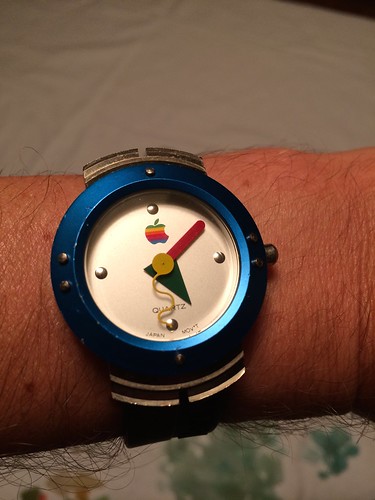
IMG_7231

Friday, January 24, 2014

Sneaking into the Macintosh launch

The Apple Macintosh was launched 30 years ago, which seems like ancient history because of course it is, but it’s fun to reflect a little on it because it brings back lots of personal memories for me – especially memories of what I think was the true Spirit of Macintosh.  In those days, most of us felt like the true meaning of computing was embodied in a company like Apple (and to a much lesser extent, Microsoft, which was barely known at the time) which were fighting the on-coming onslaught from the Big and Boring Establishment (i.e. IBM).  We wanted Apple to succeed because we thought of it as the Good Guys versus the Bad Guys in the Establishment, led by IBM with their zillions of dollars to force the world to use their software.  All we had was our ingenuity.

I was in college at the time, and I remember being pretty excited during the weeks leading up to the launch. In those days there was no world wide web where you could read up on leaks about the product, and the whole thing was shrouded in ultra secrecy. I was working part time at a small startup software company funded by a Japanese printer manufacturer that was hoping to successfully introduce a PC to the US (based on, of all things, the CP/M operating system).  But the management of the company was very interested in Apple too, and I had access to some of the early Mac stuff at the Stanford lab where I hung out.  My friends and I were also avid high tech stock gamblers investors too, so we were Apple stockholders as well, which entitled us to get into the annual shareholders meeting at the De Anza Auditorium, where we knew we could see the introduction in person.

Unfortunately, when we got there the place was packed and it was impossible to find parking,  so we agreed to split up in order to ensure we could get inside.  One of my roommates, David, was driving, so he dropped us off at the front while the other three of us, Craig, Dario, and I went inside to find seats.  But the auditorium quickly filled up and they closed the doors before David could get inside!  What to do?

Without hesitation, Craig reminded us of some advice that I still remember:  “Sometimes, if you can’t get in through the front door, you have to go in through the back door”.

So that’s what we did.  Remember, this was before cell phones, so there was no way to call each other to set up the plan.  Instead, Craig held our seats while I ran outside to find David.  Dario and I agreed that in precisely five minutes, he would be standing at the locked exit door in back and would let us back in.  I rushed outside and fortunately was able to quickly find our friend, and sure enough, Dario had the door ready for us and we snuck inside in the nick of time.  We saw the entire event – and by sneaking in we felt even more like insiders for having “beaten the establishment” just like the Macintosh Spirit encouraged us to do.

Craig’s good advice still applies today when you’re a startup forced to think creatively about how to get around obstacles.  The Established Players have the front doors all locked up.  If you want to get inside, you need to be creative – and more often than not, that means going through the back door.


[cross-posted and updated from my old blog. Photo thanks: William Wilkinson]

Sunday, August 25, 2013

Krugman on Microsoft and Apple

Paul Krugman is mostly correct:

Back in the 80s, Microsoft and Apple both had operating systems to sell; Apple’s was clearly better. But Apple misunderstood the nature of the market

He argues that Microsoft "won" in the 90s thanks to network effects it exploited when Apple's superior product was not opened to more hardware vendors. Similarly, the iPhone had an early technical lead that is sustained through network effects due to its large base of developers. Steve Jobs' controlling nature resulted in products that do some things very well and reliably, but quickly become difficult or cumbersome when you stray from whatever he thought was good for you.

My take: Complexity breeds sluggishness when promoting anything new. Apple misses plenty of niche markets they might have colonized with a more flexible approach, but they maintain agility to add new things to the existing platform -- and see them adopted. Whether this is a sustaining advantage depends much on their ability to continue picking market winners. During the 90s they lost their sense of which products were worth pursuing, under-investing in things like Quicktake digital cameras, for example, while over investing on existing products like Mac hardware (Powerbook) or OS features (OpenDoc) that proved to be less important.

By the way, I disagree with Daring Fireball on one point: although technically the Mac did ultimately succeed, that was the halo effect of iPod, etc. If Apple had focused just on the Mac, it would have remained a tiny niche.

Monday, June 10, 2013

Thoughts about WWDC 2013

My takeaways from today's WWDC announcements (in no particular order):

The UI changes for iOS7 are gorgeous, of course, and I can't wait to make the switch.  I wonder how long it'll take for developers to make the switch too. Many (most?) apps will look ancient until they upgrade to the new, flatter, look; even if the OS does most of the work for free, you can't change this much UI without making older apps look, well, old.

I see Apple finally deprecates the 3GS, but is hanging on to the iPad2. No hints, none whatsoever, about future hardware.

That first (and only) third party demo, of Anki Drive, had the potential to be very cool (hardware! and iOS! from robotics experts! ) but it disappointed, and not just because of the long delay as the company CEO tried to get it to work. Now that hardware is the new software, I'm expecting (and seeing!) some products we could only dream about in the past, so I was expecting a lot more than just another real-life game, however cool that might be. 

It's nice to see more Chinese-specific features, like the overdue Tencent Weibo integration. Looks like there will be a built-in Chinese bilingual dictionary, which is handy but a little odd to compete so directly with excellent third parties. I wonder if there'll be other dictionaries too.

I saw a new Scan API, which I hope means OS-level support for reading QR and maybe UPC codes.

Tags in OSX are a great new feature I'll use a lot, though I hope the file system embeds the tag in the document itself, so it'll work cross-platform.

There's a new "location beacon" feature in iOS7 that looks like a low-power way to let devices tell the phone that they're nearby.  I see it's supported by a new "Core Bluetooth" framework that should make it much easier to build apps to talk to all those new hardware devices that are coming.

Other features, like iCloud keychain or the new Safari features mostly just replicate functionality we've long had from third parties. I didn't see much to tempt me to switch, especially since third parties (like 1Password) are likely to quickly rev themselves to run on top of whatever new functionality Apple adds.

The iWork in the cloud, plus the promised rev of these apps later this year, is big news for Microsoft Office. As always, compatibility -- with Office and with Windows -- is a big issue, so running in the browser is the a great way to solve that.

My overall impression is that Apple continues to plod away with reasonable, incremental improvements to their platforms. Not much here is as revolutionary as some of the really big announcements we saw at recent WWDCs (iPhone 4, iCloud, Retina, etc.) but that's okay by me: I'll be upgrading as soon as I can.

Apple Developer


Thursday, June 21, 2012

Asymco's Dediu in China

Horace Dediu's asymco.com (Twitter: @asymco) is one of the best mobility analysis sites out there, so I was excited about his recent trip to China, hoping that he'd have some special insights in his Critical Path podcast with Dan Benjamin.

Alas, apparently he was only here for five days, and it was a vacation with friends, so his observations were purely as a tourist, though of course a smart guy like him can't help but notice interesting things.

He visited a PC Mall and bought some cheap cables. He was frustrated to find that Twitter/FB don't work here.  To him, China is the familiar case of a developing country that follows the Japan/Korea model of Asian development, converting "peasants into factory workers" for a straightforward boost to GDP that will bring them a long way but won't necessarily translate into an innovation powerhouse.

Most of all, he saw lots of smog, as you can see in this photo he took in Shanghai:IMG_1589

He points out that soon China will be Apple's biggest market, but he didn't dwell on the possible consequences and instead devoted most of the podcast to his take on how this year's WWDC shows Apple is becoming more friendly to an ecosystem of partners.  

Bottom line: worthwhile podcast if you want to hear more about Apple and the mobile industry, but not much insight about China.

By the way, I was intrigued to hear that, like me, he gave up regularly reading the Economist some time ago. Though filled with great writing, their perspective puts too much faith in macroeconomics which I think perceptive readers after a while lose confidence in its explanatory power. I mean, they provide an interesting well-written narrative to explain what happened, but I just haven't seen many cases where that macroeconomic viewpoint helps you see the future. 

Saturday, March 24, 2012

Mike Daisey and the fight to keep people in crummy jobs

I listened to the riveting This American Life podcast retracting its January episode "The Agony and Ecstasy of Steve Jobs", featuring the dramatist Mike Daisey, who misrepresented himself lied about the conditions under which your iPhone and iPad are produced.

For the record, I was always skeptical of media claims about worker exploitation in Apple factories. But that’s no great insight; I'm skeptical generally of the media, especially when I know a little something about the subject. Still, the discussion about journalism versus theatre shouldn’t distract us from the final question that producer Ira Glass asks in the episode:  as somebody who owns these products, should I feel bad?

From the transcript, here's the reply from a reporter whose own article has fueled the flames that Daisey started:

Charles Duhigg: So it's not my job to tell you whether you should feel bad or not, right? I'm a reporter for the New York Times, my job is to find facts and essentially let you make a decision on your own. Let me, let me pose the argument that people have posed to me about why you should feel bad, and you can make of it what you will. And that argument is there were times in this nation when we had harsh working conditions as part of our economic development. We decided as a nation that that was unacceptable. We passed laws in order to prevent those harsh working conditions from ever being inflicted on American workers again. And what has happened today is that rather than exporting that standard of life, which is within our capacity to do, we have exported harsh working conditions to another nation.

It’s easy for me, sitting here with my latte in my comfortable urban apartment, to pontificate about “the rights of workers” as I head off to my cushy high-tech management job. But I don't like one part of Duhigg’s argument: who’s the  "we" that decided certain working conditions are "harsh" and others are acceptable?

Laws didn’t end harsh working conditions; people did. Like many in high tech (or for that matter, Duhigg or Daisey), I often work 60+ hours per week. My company “forces” me to endure weeks of painful travel, separated from my family. Do you feel bad for me? No: because I know the risks, I know the alternatives, and all-up, I enjoy what I’m doing. I see it as a step toward something better for me and my children.

America’s employment laws did nothing to protect me (or you) from the harsh working conditions of the past. My life today is better precisely because of that awful labor of my ancestors, who saw it as one step in an opportunity to build a better life for their family.  Rather than fight for laws to ensure their children could have a crummy (but safe!) job in a factory, they fought to ensure their kids never ended up in a factory at all.

Why assume that we latte-drinkers are more capable of deciding tradeoffs than the thousands of unskilled laborers who line up every day begging for a job at Foxconn?  When "we as a nation" made unskilled jobs  impossible to justify in America, we didn't count the votes of those whose alternative to a factory job was much worse.

Of course, the twists of fate can be cruel and there are Bad People who will exploit the powerless.  Labor laws are one tool that can bring immediate relief.  But it’s too easy to focus only on those who directly benefit -- the existing workers, who of course are grateful -- and lose sight of those who now have no opportunity at all. By forbidding, for all time, Americans to work at jobs that are no more worse than what my grandparents endured, many of today’s unskilled workers have been shut out of the labor market, their opportunities “exported” to places where there are fewer restrictions on how unskilled people can earn money.

Higher wages won't solve the problem. Many kind-hearted people will notice that labor is a small fraction of the cost of an iPad and suggest that Apple “do the right thing” and pay the workers more. That sounds like an easy solution, but it carries its own tradeoffs.

An above-market wage makes it harder for workers to bounce through the industry. Workers who thought of this job as a stepping stone to something better may find now that it already is better. If this unskilled job pays like a skilled job, why bother with further education? For that matter, why encourage your younger cousins to make an investment in school if they can do just as well (maybe better) at the factory.

Note that above-market wages don’t just trap you in a dead-end industry; they give more power to your current employer. Sure, a tough employee or industry union would shift the power temporarily, but eventually Foxconn will notice that it can do the same work elsewhere for less money. Or worse, your higher-than-market wage might be in a company that, through no fault of yours, is not keeping up with the industry and has to lay you off.

I'm not saying that people shouldn't be paid well, especially if the work is hard. But it's impossible to know the "ethical" price for labor when you take into account all the hidden costs, including the missed opportunities for people who are trapped in jobs paying more than they're worth. Isn't it better to let people decide for themselves?

You can’t exploit robots. Ultimately, those of us who want to end harsh factory labor are on the right side of history because whether Foxconn’s labor standards meet your personal definition of “humane” or not, those jobs will eventually disappear. In fact, people like Mike Daisey are accelerating the pace at which it becomes cost effective to replace unskilled people with machines because the tiny amount of labor remaining in the assembly line isn’t worth the bad publicity.

Let’s hope the workers today can rack up enough 60-hr-week overtime put away enough savings before that happens.

Back to Ira's question: should we feel bad about how the iPad is produced?

This is where my experience in the industry leaves me bristling at the moral arrogance of those who imply Mike Daisey is “the voice of our conscience”, or conversely, that there are some evil Apple managers out there who “look the other way” at despicable behavior. If you've been to a factory, or worked with a high tech manager who does, you know: we all care. Fear not, armchair urban TV watchers: your sense of justice is no higher than those who are actually working and managing the business. If somebody like Daisey makes them seem evil to you, listen with healthy skepticism.  We high-tech managers are humans too; we don't exploit people for fun or profit -- and it's presumptuous of you to think so unless you meet us.

If you truly want to help the people who make your iPad, don't forget the ultimate goal is not menial factory jobs, however well-paid or protected. Our ultimate goal, like those of these Foxconn factory workers, or my grandparents -- should be to find something better for themselves and their families.  Anything that takes away from that goal is not a fair trade.
 

Sunday, March 20, 2011

An Apple File Store

How often have I been annoyed because I forgot to sync something on my iOS device before leaving the house. I store a lot of data in the cloud. There are my own personal files, of course, usually work-related Office documents (Word, Powerpoint, Exchange Outlook emails). But I store a lot of other stuff too:

  • Podcasts, music, photos – the normal content you associate with Apple.
  • Content apps, like New York Times or Economist. If I forget to download the latest, I won’t have it once I leave the house.
  • Personal content apps, like Instapaper or Evernote. These carry important data that fundamentally exist in the Cloud, but are useful to me only when regularly synced to my devices.
  • Other private information, like from my banking app, or Paypal, or LinkedIn.

Each of these is useful only if it’s up-to-date. If I have a network connection each time I access it, then it’s up-to-date. If not, I’m out of luck.

One straightforward way to give me this is to have something that downloads the data from each app in the background whenever I have network connectivity. I’d need to solve a few multi-task issues to make sure this doesn’t slow down the rest of my experience, but generally it would work.

But there’s a more clever way. What if there were a single, central store someplace, run by Apple, that apps can plug into. The data from each individual app would be stored there, in Apple’s central cloud. Then it would be Apple synchronizing my device, through whatever mechanism they like, perhaps even taking advantage of whatever newfangled subscription mechanism they can get away with.

How it works:

Apps like the New York Times or Instapaper or Paypal or Kindle save their data to Apple’s store, not to my individual device. Developers can continue to use whatever file IO they currently use; maybe Apple updates it to allow for more fine-grained control so it behaves more like IP packets rather than disk read/writes, but whatever: the point is that your app doesn’t need to care exactly where the data is kept.

My device has a file system just like today, except the data itself is in a cache, synchronized to the cloud, magically in the background, whenever the OS thinks it’s okay.

When I start an app on my device, it gets whatever data it needs from the on-device cache. An app that is currently running gets first dibs on the synchronization, so the experience works just like today.

Apple can also make a number of optimizations to make this system work more smoothly. First, there’s no reason to dump an item from the cache unless it needs the space. Play a YouTube video once and you have it for as long as the cache isn’t full. Same goes for Safari itself: don’t go online unless you know something needs to be updated.

Second, it can tell when the same data is being downloaded multiple times. So for example, if my RSS reader has an article that’s also being downloaded by my dedicated NYTimes app, it should only download it once. Similarly, if I have multiple Twitter clients on my device, it’ll only grab the tweetstream once.

Note that Apple can encourage third parties to do their own optimizations. If content publishers put an “official” copy in the Apple cloud, any app that wants to subscribe to that content can explicitly subscribe to the one from Apple. For example, an app that wants a map, or some Point Of Interest (POI) information in order to compute something can simply link to an Apple-hosted geo database and let Apple take care of storing and sending the original data to the device. The app does its processing in the Cloud: no need to bring it down to the device a second time.

Finally, the data of course can go both ways. Your photos or text messages or any other content you create on the device can automatically go to the Cloud, for backup or for different processing when you want it. You can ask FlickR or Facebook to get the photos from Apple’s cloud whenever it has a chance. You don’t need to explicitly do a thing.

Of course there are a bunch of privacy issues you’d need to square away before this can be implemented, but responsible data storage companies do that stuff all the time.

There are so many obvious benefits for Apple to build a system like this, I think we can assume it’s a matter of time before it shows up on a future iOS update.

I can’t wait!

Apples for sale

Saturday, March 05, 2011

Mac needs a half-way decent blog editor

Say what you want about Mac versus PC, but if you are a blogger there’s no question: Windows7 PC is better.

I’m writing this sentence on a Mac (Word 2011) and all is well: matching quotes “”, great spell- and grammar-checking, best-of-class tables, footnotes, and much more. Nothing wrong with this experience.

If this were a PC, I’d simply take this note and copy/paste to the free Windows Live Writer app, maybe add a photo from FlickR (by searching for a keyword on the fly), hit “publish” and I’m done.

Here on my Mac with the $40 MarsEdit that everyone claims is the “best on Mac”, the process is awful. Copy/Paste and (of all things!) it pastes an image of the text . Sure, I can copy/paste the HTML but I lose the formatting. Worse, once in the editor -- even the "Rich Text Editor" -- it’s not WYSIWYG: how unMac is that?

I paid the $40 because I believe in supporting small developers and because I truly need the best blog editor on the Mac. But is this the best Mac can do?

#fail


Friday, January 28, 2011

I like trucks

Steve Jobs is right:

When we were an agrarian nation, all cars were trucks, because that’s what you needed on the farm. But as vehicles started to be used in the urban centers, cars got more popular. Innovations like automatic transmission and power steering and things that you didn’t care about in a truck as much started to become paramount in cars. … PCs are going to be like trucks. They’re still going to be around, they’re still going to have a lot of value, but they’re going to be used by one out of X people

But after living with an iPad since it was available last year, I'm thinking I still like trucks.  Most mornings I've been using Flipboard or Reeder to watch my various RSS feeds. But while the iPad is nice for lying in bed, or for spontaneous and quick reads when I have a minute to myself, it just can't beat the power of a truck, er, laptop.

I just outfitted myself with the updated NetNewsWire 3.2.8, the one with the new Instapaper button. I need Instapaper so badly that I considered switching  (to Shrook, the only interesting-looking one in the Mac App Store, but I gave up when I found it doesn't sync to Google Reader), but now that I have it, I'm wondering why I don't stick to Mac for all my serious RSS reading. I also added the NetNewsWire to Evernote Applescript on the Veritrope site; that plus the FastScript utility from Red Sweater Software, and I'm just a command-E away from sending all my interesting clippings immediately to Evernote for safe-keeping.  Try that on your iPad.

Sometimes a truck really is better.

Trucks having a hard time passing each other (China)

Truck in China


Friday, September 24, 2010

How to use an iPhone over Ethernet

Okay, you're not really doing iPhone directly over Ethernet, and you'll need a Mac close by to do it, but this is a trick I find handy in hotels that offer wired ethernet for free, but where they charge for WiFi (like Marriott Changfeng Park in Shanghai).

Set up your Mac (I use a MacBook Pro) to do internet sharing over Airport, and you can become your own WiFi hotspot, easily connected to from your iPhone or iPad.

Under System Preferences (available under the apple menu), under "Internet and Wireless", select Sharing, and do this:

Internet Sharing (Mac)

Note: I have file sharing turned on as well, but that's not necessary (and normally it's a good idea to keep it turned off).

Also, remember that you'll have to uncheck the Internet Sharing box before you can select different ways of sharing your connection.  You'll want to select "AirPort" to create the WiFi hotspot.


Saturday, June 27, 2009

A Switcher with second thoughts

I'm a veerrry long-time Mac user.  I had one of the first 128K Macs.  I dropped out of college for a while with some friends to develop one of the first Mac applications.  I  worked at Apple for 6 years.  So I am pretty excited about getting back to Macintosh, after having gone to Windows for the past ten years (after my company was bought by Microsoft).  But now that I'm in my second week as a Switcher, I'm frustrated.  The Mac just isn't as great (compared to Windows) as I had hoped it would be.

I'm using an old Macbook Pro with 2GB, so you can probably start by laying the blame on an older machine.  But here are some of my initial frustrations:

  • Macbook Pro keyboard and trackpad placement are poorly designed: my thumb has to travel very far to get to the mouse click.
  • The mouse seems more critical than on a PC, where nearly everything is easily available with keyboard shortcuts, which I miss. Where's the ALT key?
  • Video capture doesn't work out of the box. I plugged my camcorder into the firewire port but nothing happened. What's this about Final Cut?  Is it not standard on a MacBook Pro?
  • The battery is super hot.  I mean, I can't have it on my lap while I'm wearing shorts.  Ouch!
  • So many things are slooooww.  Safari seems to take forever to load pages, for example.  Maybe this is caused by the lack of RAM, but my Windows laptop is also 2GB.  Is the hard drive speed slow?

I should write up the list of things I like, because there are many of those things too.  I like the built-in video camera, and the super-cool geek factor of having a full-blown Unix machine at my fingertips.  I also love being able to set up my HP printer with absolutely no extra steps -- it just worked! There are no doubt many more things I'll prefer after having a few more weeks at this.  But in spite of a few nice things, I'm sorry that so far I haven't been blown away.  I guess you need to give me a few more weeks to play and ask me again which I prefer.

IMG_9992