Sunday, December 18, 2011

Zeo vs. the motion sensors

I don't have a Jawbone UP. I tried to buy one earlier this month but Best Buy wasn't stocking them until the kinks have been worked out. Several of my friends rave about it, though:  it's just a bracelet that you wear and it automatically measures your activity, including your sleep.

The UP is one of a number of devices that try to measure sleep based on your movement in bed. It has a tiny accelerometer that picks up the slightest little twitches of your hand while sleeping. Since sleep phases are often accompanied by such movement,  (the theory is) software can later stitch it together to guess how much time you were in REM sleep or deep sleep. But these twitches are just a proxy for the actual sleep phase,  so I'm skeptical that it can measure it as accurately as the Zeo, which uses special sensors to directly detect the electromagnetic activity in your brain. Still, maybe it's "close enough", especially if (like me) you don't have any particular sleep issues that need analysis to the nth degree.

Movement detection is pretty easy, and there are plenty of ways to do it.  There's even an App for that! Smart Alarm, by Arawella Corporation, cleverly uses the built-in accelerometer, plus the microphone, to measure your movement at night and guess the amount of various sleep phases.

How does it compare to my Zeo Sleep Manager?  Last night I tried both at the same time and here are the results:

myZeo Personal Sleep Coach


Smart Alarm Sleep

Answer: Zeo is way better. It’s not even clear that the motion-detection app gave useful information, and might even be outright wrong.

The motion detection method was wrong. It says I:

  • Slept one hour longer than I did. (9 hrs vs 8)
  • Had more phases of REM sleep (6 vs. 4)
  • Had less deep sleep (5 vs. 8+)

Look at the charts and you’ll see the difference.

I don’t know how well this compares to an UP, but I bet the motion-detection systems just aren’t very useful.  If you really want to measure sleep, I say get the Zeo.

By the way, my recommendations:  Zeo comes in two forms: an alarm clock version that doesn’t require anything extra; and a more portable, cheaper version that plugs into your smart phone. If you have an iPhone or an Android, the Mobile Sleep Manager is a little cheaper and smaller.  The Alarm Clock version is nicer if you don’t already have a nice bedside alarm clock, or if you don’t like sleeping near your phone.

Saturday, December 17, 2011

I'm sleeping better, but why?

I love my Zeo Sleep Manager, a cool device that measures my brain activity in order to help understand the quality of my sleep: the amount of refreshing REM versus Deep sleep, versus plain-old-ordinary light sleep, and of course the all-up total sleep each night. I started using it in mid-2010, and have used it to track my sleep most nights since then.

I don't have any particular sleep issues, though I was intrigued by the idea that I may be used to a particular quality of sleep, and maybe I just think I'm doing okay. Well, after using Zeo for this long I can't say that I feel all that different -- I feel fine, and always have -- but feelings are hard to measure objectively. Is there a way to measure my sleep quality more scientifically?

Zeo uses a measure they call "ZQ", which tries to combine a bunch of aspects of sleep into a single number you can compare across nights. After analyzing my data for the past eighteen months, I've noticed that my ZQ number seems to be going up over time, for no apparent reason.  At least, I don't think I've been changing anything about myself: I just go to bed when I'm tired, and wake up when it's morning. I haven't deliberately tried to change anything about myself.

But even without trying, my ZQ seems to have improved over the past year.  Since the amount of daylight varies throughout the year, I analyzed my numbers date by date.  (I don't have data for every single night, so my analysis skips the nights when I don't have a datapoint for both years).

Here's a chart that shows the difference in my ZQ compared between given dates in 2010 and 2011.

Sprague ZQ 2011 vs 2010

As you can see, there seems to be a clear trend of my ZQ improving, and for the past few months it's improved significantly – on the order of 20 or more points per night. I wonder why?

Sunday, December 11, 2011

Worse than a robot

I’m back in the US for a few days, a good time to order items that I can’t get in China, and that means borrowing the address of a friend to accept delivery. Since I come often, I try really hard not to wear out my welcome with these friends by making the pickup process as simple as possible.

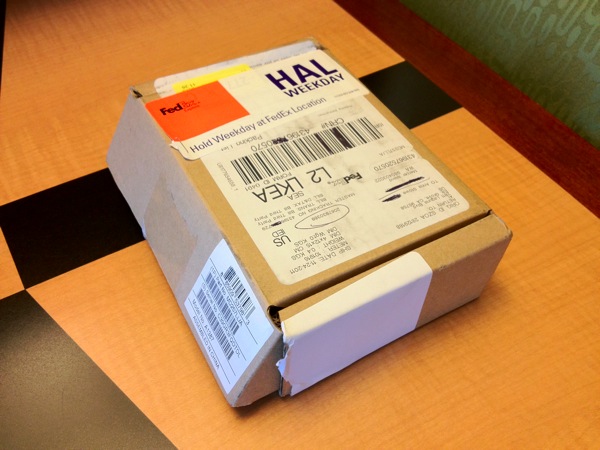
This time I needed wanted a new iPhone 4S, which can have unpredictable arrival times, so I ordered it several weeks in advance. My friend happened to be out when the truck came, and I got an email notice offering to hold it instead at the main FedEx shipping center. Perfect! I thought: I’ll pick it up right after my plane arrives, early in the morning  with no need to intrude on my friend.

Seemed like a perfect plan until the lady at the FedEx counter asked for my ID. Of course I have my passport/drivers license, but the package was delivered to my friend’s name, and as the lady explained to me: “FedEx policy requires that the name on the package match the ID of the person picking it up”.

Well what I can do? I’m obviously who I say I am -- she sees my ID -- and I have the correct tracking number. It’s clearly my package. But policy is policy, according to the  counter lady. My only hope is to get my friend to call FedEx and change the name on the delivery. I explain that it’s early in the morning, my friend did me a favor by accepting delivery in the first place, and I don’t want to impose.  Sorry, she says.  “It’s policy”.

“Wait,” I say. “What’s to stop me from calling FedEx myself?”  I know the tracking number, the address of the original delivery, and I have an email that FedEx sent to me. Rather than ask my friend to call, why don’t I call myself, pretend to be the friend, and the problem is solved, right?

The counter lady hesitates. I have a good point, she admits, but now that she’s on to me, she says, she still won’t let me have the package because she’ll know it was me just faking to be my friend. The only thing I can do, she insists, is call my actual friend and get her to dial FedEx herself.

But that’s a hassle for my friend, who will have to drop what she’s doing to make a phone call, look up the tracking number, sit on hold.  I really don’t want to impose.  Too bad, says the counter lady. “Policy is policy”.

I called Apple. The person on the line was very friendly and accommodating, but Apple’s IT systems and FedEx IT systems are separate, so it could take as long as 24 hours before word of the different name on the address trickles into the FedEx office. The Apple person offers to speak directly to my FedEx lady, who replies “Nope: it’s policy”.

Finally, after too much time wasted already, I excused myself and went outside. I called FedEx and said I want to change the name on the delivery. No problem, they said. A few minutes later I went back to the counter lady, she looked up the entry and sure enough it’s okay to accept delivery from “Richard Sprague”.

Ugh.  What a waste.

This counter lady adds no value. By sticking so firmly to the rules, she was making herself into an automaton, the perfect job for a robot. Unlike a machine, though, she can’t work twenty four hours a day, and she needs to be paid.  So she’s actually worse than a robot!

If, on the other hand, she had used a little common sense -- the kind that is far more complicated to program into a robot -- she could have realized that my story makes complete sense. I am showing her a real ID, and I’m happy to give real additional contact information in case --against all logic--I am a criminal who somehow stole this tracking number, faked the email I showed her, and now is going through all the trouble of coming to the FedEx office -- in person -- to pick up a delivery of a brown box that has no indication of what’s even inside.

The US unemployment rate is too high, and there are a lot of proposals for how to “put America back to work”. But the unfortunate fact is that too many Americans are like this FedEx counter lady: doing work that is fundamentally replaceable by automation and robots. I don’t know what this particular women will be doing in five or ten years, but I know that if FedEx wants to continue controlling costs, they’ll need to look carefully at how much value she adds, and inevitably they will conclude that a robot is better for this work than she is.

It’s sad, because she, like all humans, has some skills that are extremely hard to replace with machines. But first she’ll need to start acting like a human, and not like a robot.

IMG 3843


Saturday, October 22, 2011

Don’t study engineering or science

Thomas Friedman writes today in his column, One Country Two Revolutions

if one result of the downsizing of Wall Street is that more of America’s best and brightest math and physics students decide to go into science and real engineering rather than financial engineering, the country will be a whole lot better off.

The rest of the article is a glowing account of Silicon Valley and some of the inspiring people he wants us to emulate.  Just for fun, I looked up the education histories of the people he cites:

  • Alan Cohen, VP at networking company Nicira (MBA, MA Int’l studies)
  • Scott Wilson, designer mentioned in Fast Company (B.A. Design)
  • Alexis Ringwald, founder of an education startup (B.A. Political Science)
  • Marc Benioff, CEO of Salesforce.com (B.S.B.A. Entrepreneurship)
  • Jeff Weiner, CEO of LinkedIn (B.S. Economics from Wharton)
  • Jagdish Bhagwati Professor at Columbia is of course is a BA Economics.

(By the way, Mr. Friedman himself has an undergraduate degree in Mediterranean Studies)

Not a single one of the people he praises is an engineer or scientist!

Like I said after watching the education movie 2 Million Minutes:  Science and engineering are important, but by themselves they are technical skills, like welding or car repair, that can be mastered by anyone with some discipline and training.  You need to be much smarter than that. I’m reminded of the common entrepreneurial wisecrack: “If I need an engineering degree, I’ll hire one”.

China and India have plenty of engineers and scientists.  To compete in the future, we need innovators and risk-takers, along with a culture that encourages people to try new things, even things the “experts” and regulators think are too risky or likely to fail.  The future belongs to people with curiosity, open minds, willingness to change, an ability to empathize with people of different backgrounds, work well with others, and a society with enough flexibility and freedom to allow for many ways of getting there.

If science and engineering are your passion, by all means go for it. But if you (or your kids) are studying it just because experts like Thomas Friedman say you should, then you’re missing the whole point.

Thursday, October 06, 2011

What happened to me?

I just spent eleven nights in the hospital – four of them in ICU. I’ve always been a pretty healthy guy. What happened?

The short answer: a bowel obstruction – a kink somewhere in my intestines that kept food from passing through – plus aspiration pneumonia, which I contracted shortly after they inserted a three-meter tube through my nose and into my tummy.

Exactly two weeks ago, I boarded a plane to return to Beijing feeling a little tummy ache – I thought it was some Mexican food I’d eaten – but the high altitude of the flight – which tends to bloat the internal organs—apparently worsened the situation enough that I was pretty sick by the time I arrived, unable to hold food or water. I pulled myself together enough to complete my MacWorld keynote address, and then headed straight to a clinic for treatment.

Those horizontal lines are not good: it means something is blocking the normal passage of liquids.

Bowel obstructions are nearly unheard of in younger people, but in my case the cause is clear: abdominal surgery as a child left bits of scar tissue that accumulated over the years enough to occasionally wrap around the intestines. Although full obstructions can be somewhat common with a history like mine, I lasted nearly thirty years without trouble, and I’m hopeful that this time was just a fluke that won’t bother me again.

Treatment is pretty straightforward: doctors insert a tube to let the pressure off the obstructed area, and wait for it to heal naturally. Doctors try hard to avoid surgery – after all, it’s the surgical scar tissue that causes the problem in the first place –but it’s always a backup option in severe cases. I’m recovering fairly well, so that doesn’t seem to be a necessity for me.

The pneumonia, meanwhile, made my situation worse than it might have been. We’re not sure how I contracted it. I had a bit of a cold the previous week – did my weakened condition cause it to flare into something worse?  Or, maybe in the process of inserting the tubes, something in my throat disturbed the lungs somehow and tipped me into a much worse situation?  Either way, this was quite a scare and it necessitated the ICU, a week of breathing with an oxygen mask, and plenty of antibiotics, which I’ll need to continue taking for several more weeks.

It’s been two weeks and although I’m much improved, I’m not out of the woods yet. I’m recuperating at home, which of course is much better surroundings than in the Chinese hospital I left. This week is a Chinese holiday, and while it’s a bummer that I can’t get out and enjoy the vacation, I’m not missing any work either. For now I’ll just continue this way, taking it slowly until I’m back to my old self.

Saturday, August 27, 2011

[Book] 1493


The New World was created, not discovered, says Charles C. Mann. The impact of Columbus’ historic trip was felt worldwide, ushering in the Age of Globalization that we know today. Nearly everything, worldwide, changed so much as to make the pre-Columbian world unrecognizable. Can you imagine Italy without tomato sauce? Ireland without potatoes? Georgia without peaches?

I was surprised to see that this book is as much about China as it is about America or Europe. In fact, the author did much of his research in China. This is more obvious than it seems: after all, trade with China was the ultimate goal of Columbus and the generations that followed him.

There is a lot to this book and I know I’ll think about it for many years to come. If I had more time or motivation, I’d write a proper summary, but in these days of super-short tweets and instant-access Google, let me just summarize a few of the more interesting takeaways, since I know I’ll likely want to refer back to these ideas later:

  • Columbus’ largest ship, Santa Maria, ran aground on his first voyage, so he had to leave 38 people behind. When he returned eleven months later, they were all dead—the result of conflict with the locals (called Taino).
  • The non-human travelers to America were at least as important as the explorers themselves: bacteria and viruses caused epidemics, insects destroyed native crops.
  • Earthworms were unknown in America until the Europeans arrived. Imagine the soil without them, and all the consequences on mulch and the types of trees possible and much, much more.
  • Trade with China began in the 1560s in Manila.
  • The period of unusual cold known as the Little Ice Age, from 1550 to 1750, may have been caused by the end of wide scale forest burning by native Americans.
  • The Virginia joint-stock corporation shipped seven thousand people to Virginia between 1607 and 1624, of whom eight out of ten died.
  • Tobacco saved England’s New World investments: by 1680 it was exporting 25 million pounds per year.
  • Nicotine addiction was rampant worldwide by the early 1600s: in 1635 the khan Hongtaiji prohibited tobacco. Guangxi Chinese were making tobacco pipes by 1549.
  • The flintlock rifle, which first became available in the late 1600s, was the first weapon that Indians recognized as superior to the bow. John Smith’s matchlocks didn’t work in wet conditions and required a tripod for accuracy.
  • Malaria killed untold numbers of people in the Americas and was common even in New England. Africans, with their “Duffy antigens” were immune and became ideal laborers as a result.
  • One reason Zheng He’s historic travels from China weren’t followed up: he never encountered a nation richer than his own. “For the same reason the United States stopped sending men to the moon – there was nothing there to justify the costs of such voyages”.
  • The Ming prohibited all private seagoing vessels in 1525 (but reversed the order fifty years later in order to trade with Europeans in Manila).
  • Wokou (倭寇) Japanese pirates were a serious threat to trade.
  • Yuegang, near modern Xiamen, was one of the world’s most important ports in the 1600s.
  • By the 1570s, 90% of Beijing’s tax revenue came in the form of silver coins.
  • Potosi, Bolivia’s “mountain of silver” was discovered in 1545. By 1611, its population of 160K was as big as London or Amsterdam.
  • The Qing dynasty enacted a program of smallpox inoculation.
  • “Part of the reason China is the most populous nation is the Columbian exchange” (p177). New, highly productive crops like sweet potato and corn enabled cultivation in otherwise impossible areas.
  • For 167 days in 1925 two Polish researchers lived on potatoes with butter and reported no health problems. [p197]
  • “Roughly 40 percent of the irish ate no solid food other than potatoes”. [p209]
  • Tenochtitlan fell on August 13, 1521.
  • P.312 : 57% of the early descendants of Conquistadores tracked were of Indian descent.
  • P.313 In 1640 there were 3x as many Africans as Europeans in Mexico.
  • P323: Katana-swinging Japanese helped suppress Chinese rebellions in Manila in 1603 and 1609. When Japan closed its borders in the 1630s Japanese expatriates were stranded wherever they were.
  • P.359: English Puritans launched two colonies, one at Plymouth and another off the coast of Nicaragua in 1631.

Like I said, very interesting and there’s a lot more. If you like history in general, or if you’re looking for a fresh take on China, this is definitely worth reading.

Wednesday, June 29, 2011

The Chinese Twitter (English version)

Now available on the US App Store: Sina Weibo 微博 download here: http://itun.es/igk6zp then follow me at http://weibo.com/2140336255 and see why 200M users like it.

Note: to create an account you'll need some rudimentary knowledge of Chinese (either from something like Google Translate or from a helpful friend).  I assume they're working on an English version of the web site too of course.